Home /Why Your Boiler Keeps Losing Pressure
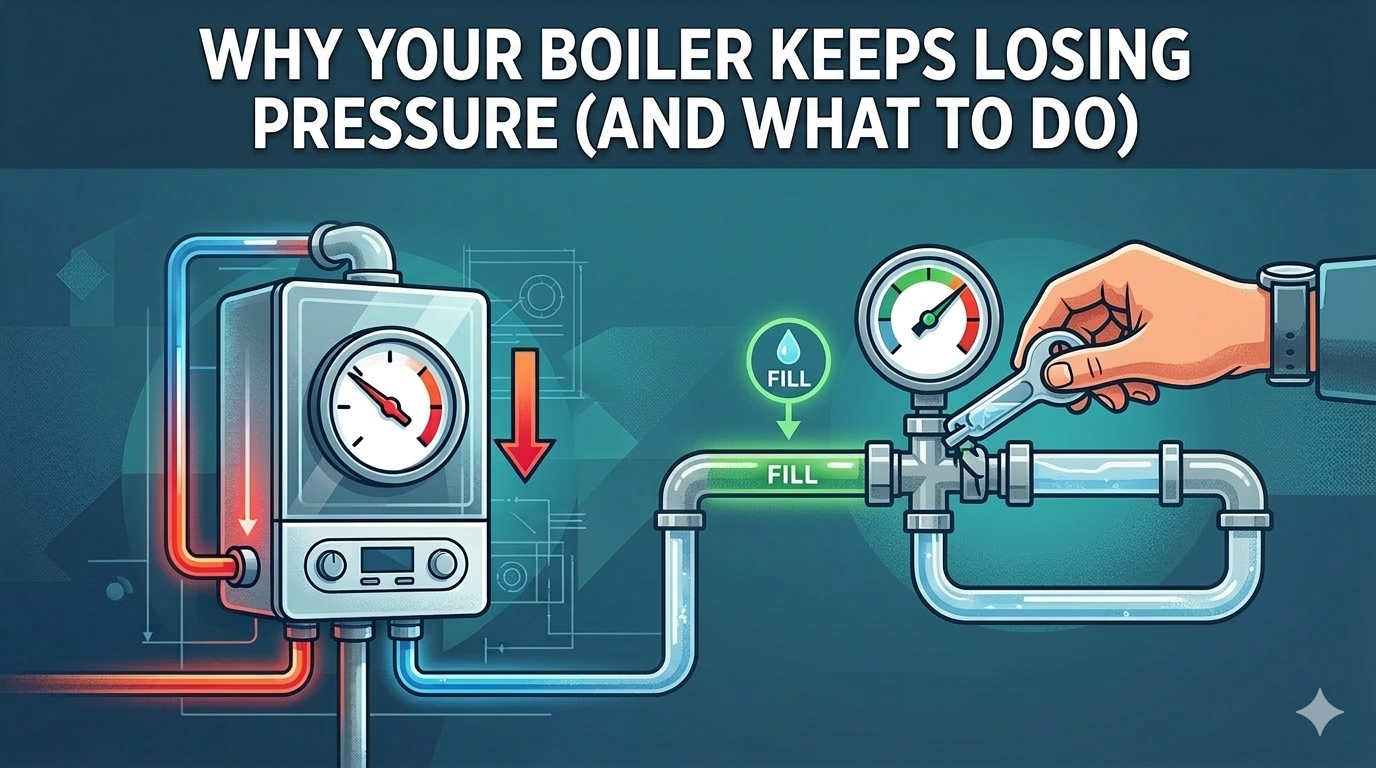
When your boiler pressure keeps dropping, it’s a clear indication that there’s a malfunction within your heating system. Initially, low boiler pressure may not seem like a big problem, but it can definitely impact heating performance and could result in major issues if overlooked.
Normally, the suitable pressure for a boiler should be at the level of 1 to 1.5 bar when the heating system is not running. If the pressure keeps dropping below that range, the boiler may stop working, failing to heat your home as required. To determine whether it is a simple problem that can be fixed by the homeowner or if it needs emergency boiler repair services, let’s consider the common reasons behind the dropping pressure of the boiler.
The most typical cause for pressure loss is a leak in the heating system. A very small leak in a radiator valve, a pipe joint, or even an underfloor heating connection can slowly lower the pressure of the system over time.
Leaks aren’t always what they seem at first. Sometimes the water is gone so fast that it leaves hardly any trace. In some cases, you may discover damp spots by the radiators, discoloration on the ceilings, or rust around pipe ends.
If you think there might be a leak, you should definitely do something quickly. An expert boiler engineer can pressurise the system and find even the hidden leaks before they get worse.
Read More: Common Causes of Boiler Leaks
If you have any air trapped in your radiators and you have bled them recently, the pressure drop can be the result of that as well. When you bleed, it is not only air that is released from the system, but the pressure inside is also, to some extent, lowered.
After bleeding the radiators, the boiler will usually need to be repressurised, which is normally achieved by opening the filling loop. This is a simple procedure, although it is always important to refer to the manufacturer’s instructions.
If the pressure continues to drop after the boiler has been repressurised, then the fault is not necessarily caused by airlocks.
A pressure relief valve is a critical safety feature that releases excess pressure in the system when it becomes too high. However, a non-functional or a stuck valve can cause water leakage even at normal pressure levels.
Such a type of leakage can lead to a gradual loss of pressure. You may also observe water dripping from the overflow pipe. In this case, it is not recommended that you attempt any DIY fixes. Instead, it is advised that a qualified boiler engineer checks the faulty PRV and replaces it if necessary.
If the PRV malfunctions, it can result in the shutdown of the system.
The vessel is important in keeping the pressure steady. It is responsible for absorbing the expanding water when it is heated. When the vessel loses its air charge or develops a fault, the pressure of the boiler changes dramatically.
You might have noticed that the pressure is rising too high when you turn on the heating, and then drops when you turn off the heating. Such a fluctuating action usually indicates a faulty expansion vessel.
Replacing or recharging an expansion vessel is a task that requires expertise. Emergency boiler repairs are usually required in most situations.
However, over time, all boilers and heating systems have to undergo some level of wear and tear. For instance, corrosion in any radiator or pipe may lead to some form of weakness that may later become a source of leakage.
If your boiler has been in use for over ten years and you have constant pressure issues, it may be an indication that it has started to deteriorate. A boiler engineer should be called to determine whether repairs are necessary or if replacement parts are needed.
If you notice that your boiler pressure is running low, you should check the pressure gauge first. If you notice that the reading is below 1 bar, you should consider topping it up with the filling loop. After topping up, you should keep an eye on the pressure for the next few days.
If you notice that the pressure is dropping again, you should not ignore it, thinking that it will go back up on its own. This is not true, as dropping pressure is usually a sign of a problem. Repeatedly topping up the pressure can cause even more damage to the internal components of the boiler.
You should check for leaks on the radiators, valves, and pipes, both inside the house and outside, where the boiler is located, on the overflow pipe. However, you should not attempt to open the sealed components of the boiler, as this can be dangerous.
However, if pressure loss is regular, if you notice signs of leakage, or if it shuts down entirely, then it is time to seek professional help from a boiler engineer. It is important to note that attempting to fix complex issues without proper knowledge may be hazardous and may cause damage to your boiler.
Emergency boiler repairs may be required if your boiler has completely stopped working, especially during winter. This ensures that you do not spend a fortune on repairs while at the same time keeping you warm in your home.
A boiler that is continually losing pressure is not something to be taken lightly. Although small issues like recently bled radiators can be easily resolved, constant loss of pressure is a symptom of a leak, valve problems, or a problem with your expansion vessel.
Keeping an eye on your pressure gauge will enable you to quickly address any issues and, therefore, avoid major problems arising. Nevertheless, if you lack the confidence to do the repairs on your own, the most prudent choice is to hire a professional boiler engineer who can provide you with an emergency boiler repair service.
It is indeed completely normal for the boiler pressure to drop a bit over time; in fact, this drop should be quite small. Frequent reduction of boiler pressure is usually a problem that requires attention.
Yes, you can occasionally repressurise your boiler, but you should be aware that topping up the boiler pressure repeatedly can cause additional damage.
In case the boiler has completely stopped working, is leaking, or has stopped working in cold weather, emergency boiler repair is necessary.
Low pressure might impair the performance of the boiler, and if ignored, it might cause stress on the internal components.
It is recommended that the boiler be serviced annually by a qualified boiler service engineer.
 Need Help? Call Now